
AI Data

EyeChip Turns Human Attention into AI Data

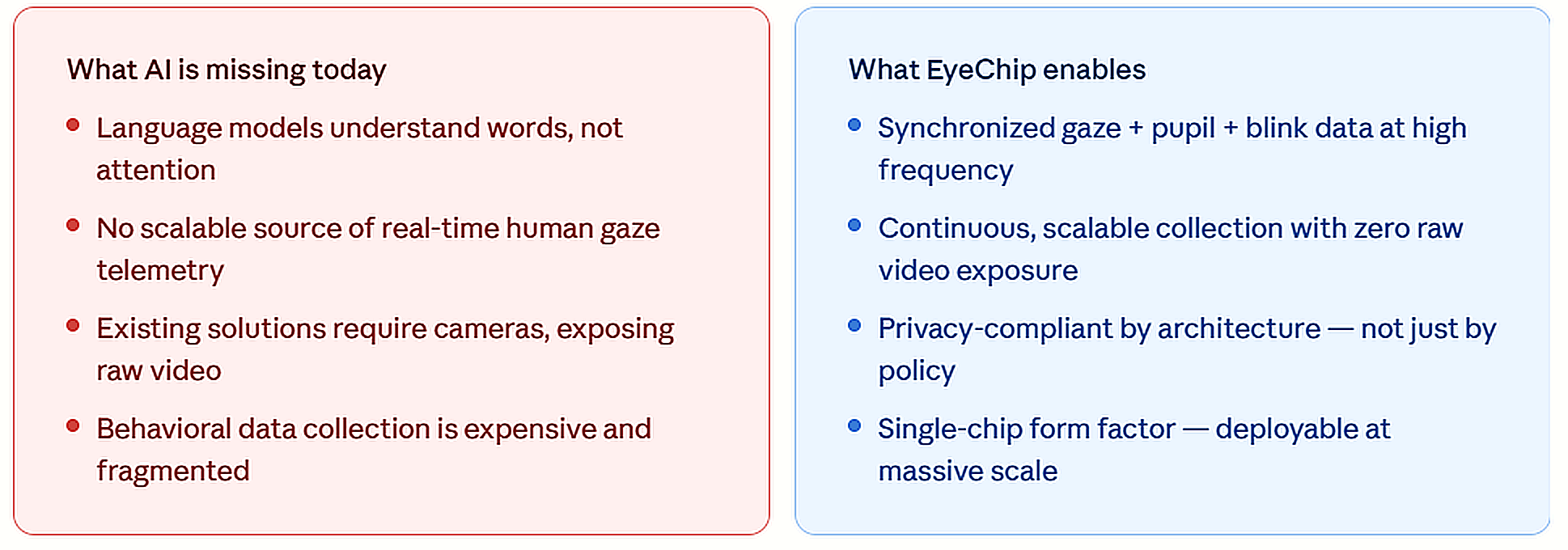
AI systems today are built on machine data — sensors, logs, and environmental inputs — but they lack real-time understanding of human attention, intent, and cognitive state.

EyeChip introduces a new input layer: human attention data.

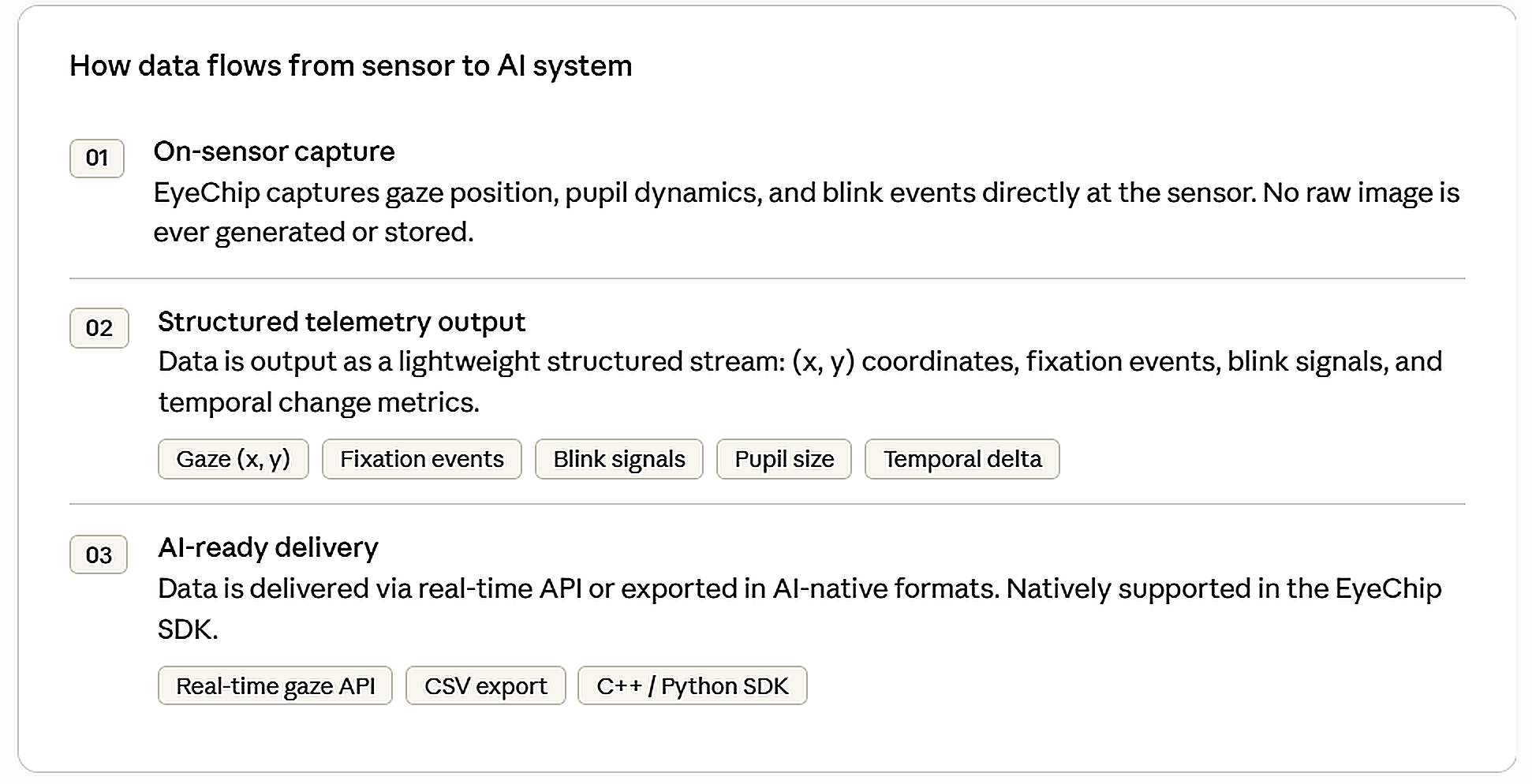
By capturing and processing eye movement directly at the sensor, EyeChip transforms human behavior into structured, real-time signals that AI systems can immediately use — without relying on continuous raw video.

EyeChip outputs synchronized, AI-ready data streams designed for direct integration into AI systems:

  • Gaze direction and focus
  • Fixation stability
  • Pupil size and dynamics
  • Blink events
  • Attention patterns
  • Confidence and signal quality

These signals provide a continuous understanding of human state, enabling AI systems to move beyond passive observation into real-time awareness.

Traditional vision-based AI systems depend on continuous video streams — creating unnecessary data load, high latency, and significant infrastructure cost.

EyeChip eliminates this inefficiency by generating only the data AI systems actually need.

This results in:

  • Lower bandwidth and storage requirements
  • Reduced compute load on processors
  • Faster response and lower latency
  • Simplified system architecture
  • Scalable deployment in edge environments

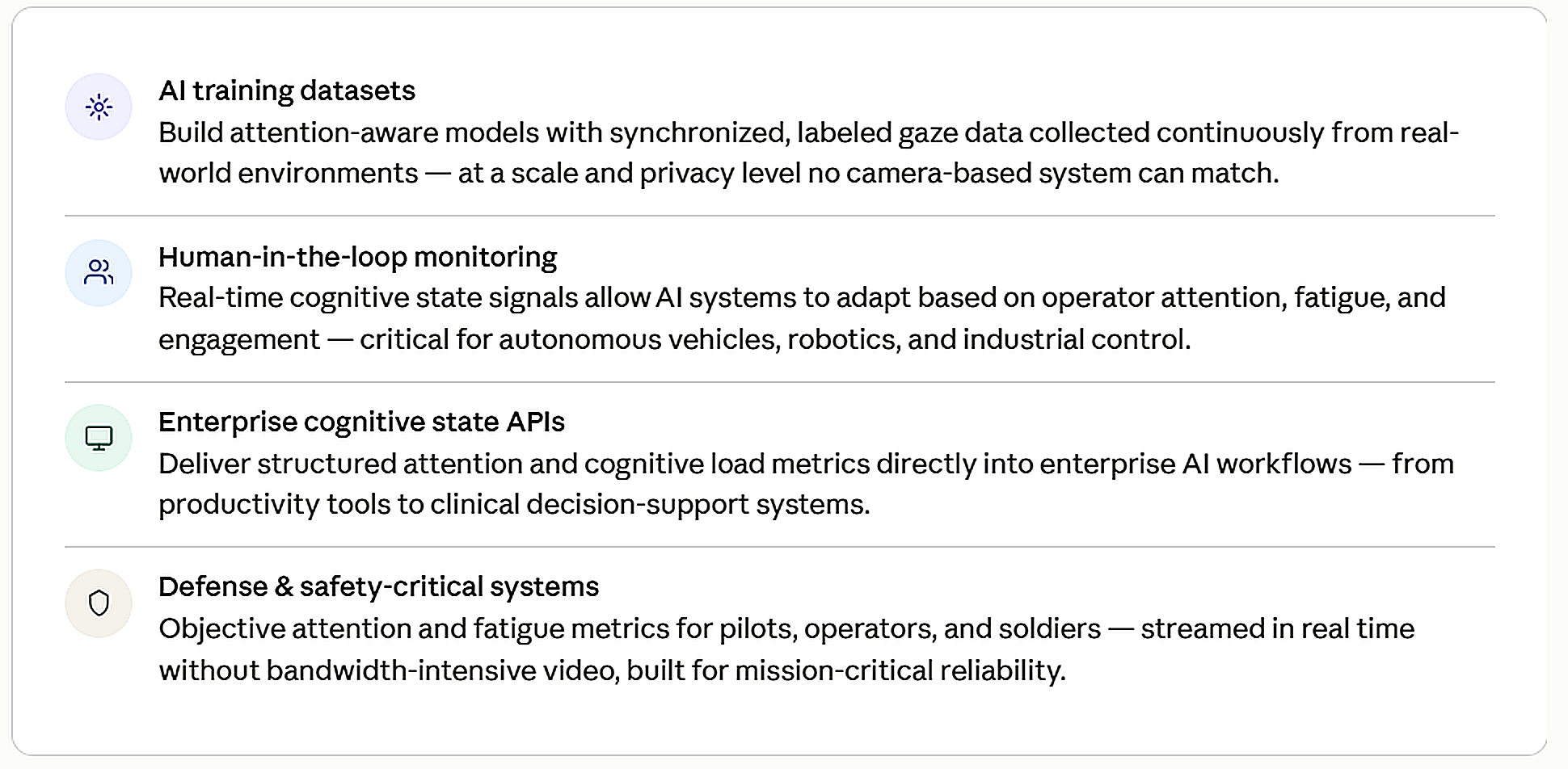
By enabling real-time human awareness, EyeChip unlocks new capabilities across industries.

In industrial and energy environments, it enables operator vigilance monitoring and safety awareness.
In automotive systems, it supports driver monitoring and cabin intelligence.
In XR and training systems, it enables attention-aware interaction and immersive learning.
In healthcare, it provides new insights into cognitive state and neurological conditions.

EyeChip is designed with a privacy-first architecture.

By removing the need for continuous raw video streaming, it reduces exposure of sensitive visual data and enables deployment in environments where security and data governance are critical.

Its edge-native processing approach aligns with modern requirements for data sovereignty, secure infrastructure, and scalable AI deployment.

EyeChip is not just a sensor — it is a foundational data layer for AI.

By standardizing how human attention is captured and delivered, EyeChip enables a new class of AI systems that understand both machines and humans.

This is the beginning of attention-aware AI.