

Applications Across Industries
With its expanded dataset and clinical-grade performance, the EYECHIP powers advanced solutions in diverse fields:
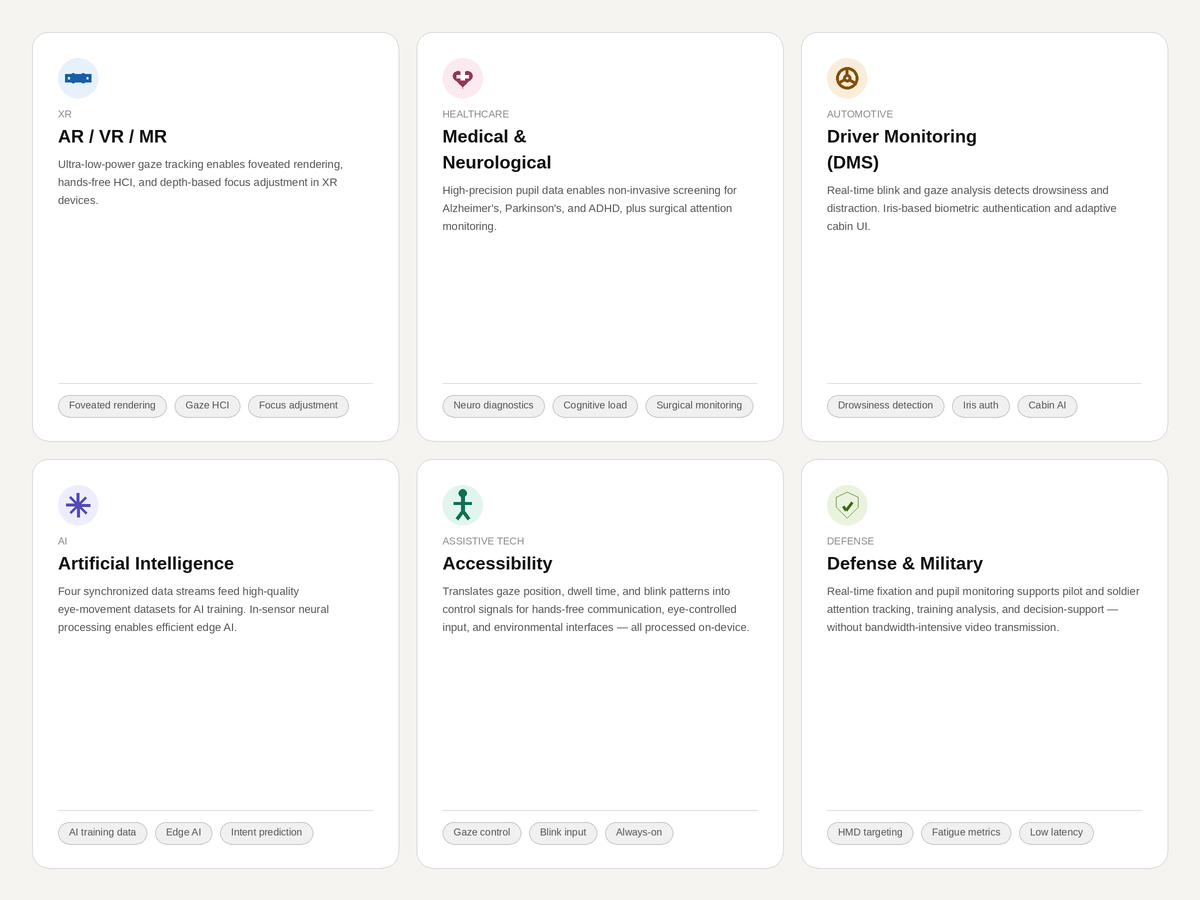
1. XR (AR/VR/MR) – Built for Lightweight, Always-On Devices
EYECHIP’s ultra-low-power, low-latency, and compact size are critical for the power-constrained environment of XR devices.
- Foveated Rendering: Uses real-time pupil center coordinates to render only the central fixation point in high resolution, significantly reducing GPU load and power consumption while maintaining perceived graphical quality.
- Intuitive Human-Computer Interaction (HCI): Enables natural, hands-free interaction such as gaze-based selection, scrolling, and clicking to enhance the user experience (UX) within the virtual environment.
- Depth Sensing and Focus Adjustment: Analyzes changes in pupil size variation to potentially estimate distances to virtual objects or automatically adjust the focus of virtual lenses.
2. Healthcare (Medical and Neurological Diagnostics)
The chip’s high-precision pupil size and movement data provide a non-invasive tool for assessing neurological status and cognitive load.
- Neurological/Psychiatric Diagnosis: Measures real-time pupil size variation to objectively track stress levels, fatigue, and cognitive load. It aids in the early screening and diagnosis of conditions like Alzheimer’s, Parkinson’s disease, and ADHD by analyzing drug-induced or cognitive-task-induced pupil response patterns.
- Surgical Monitoring: Monitors the attention and concentration of surgeons or medical personnel during critical procedures, helping to prevent potential errors due to fatigue or distraction.
3. Automotive (Driver Monitoring Systems, DMS)
EYECHIP’s ultra-low power and low-latency features, combined with Glint detection, are essential for safety-critical monitoring in vehicles.
- Drowsiness and Distraction Detection: Analyzes blink rate, duration, and gaze deviation in real-time to immediately detect and warn the driver about drowsiness or distraction.
- Driver Biometric Authentication: Uses the driver’s iris or pupil pattern for biometric authentication to automatically start the vehicle and load personalized settings.
Customized Interface: Determines where the driver is looking (e.g., dashboard, center console) to automatically highlight relevant information or provide contextual alerts
4. AI (Artificial Intelligence) Data
The rich, synchronized data streams provided by EYECHIP are valuable for training next-generation AI models.
- AI Training Data Set: Supplies the four synchronized data streams (high-res image, precise coordinates, pupil size, glint position) to build high-quality Eye-Movement datasets, allowing AI to more accurately learn and predict user intent, emotion, and cognitive states.
- Edge AI Acceleration: The In-sensor neural processing completes eye-tracking analysis directly on the chip, enabling fast and efficient AI computation on edge devices without relying heavily on cloud processing or external GPUs.
5. Assistive Technologies for Accessibility
Provides a reliable, non-invasive interface for individuals with limited mobility by translating eye movements into actionable control signals. EyeChip processes gaze position, dwell time, blink patterns, and pupil variations directly on-device, enabling accurate and responsive interaction without reliance on cloud processing.
This enables hands-free communication systems, eye-controlled input devices, and environmental control interfaces. The low-power, always-on design ensures consistent performance for long-duration use in assistive applications, while minimizing system complexity and hardware requirements.
6. Defense & Military Systems
Delivers real-time monitoring of operator attention and visual focus in high-demand operational environments. EyeChip captures and processes eye movement patterns, fixation behavior, and pupil responses at the sensor level, enabling continuous situational awareness without bandwidth-intensive video transmission.
These capabilities support pilot and soldier monitoring, training analysis, and decision-support systems by providing objective metrics of attention, fatigue, and cognitive load. The robust, low-power architecture is optimized for deployment in constrained and mission-critical systems requiring high reliability and minimal latency.